
Human Trafficking Awareness Month is not only about recognizing that trafficking exists; it’s about understanding where accountability is missing and what needs attention for real prevention to occur. Awareness, when grounded in accurate information, creates the conditions for intervention, public pressure, and systemic change. Without it, exploitation remains hidden and accountability remains optional.
This moment invites a deeper look at who is (and is not) being held responsible.
Buyers: The Engine of Demand
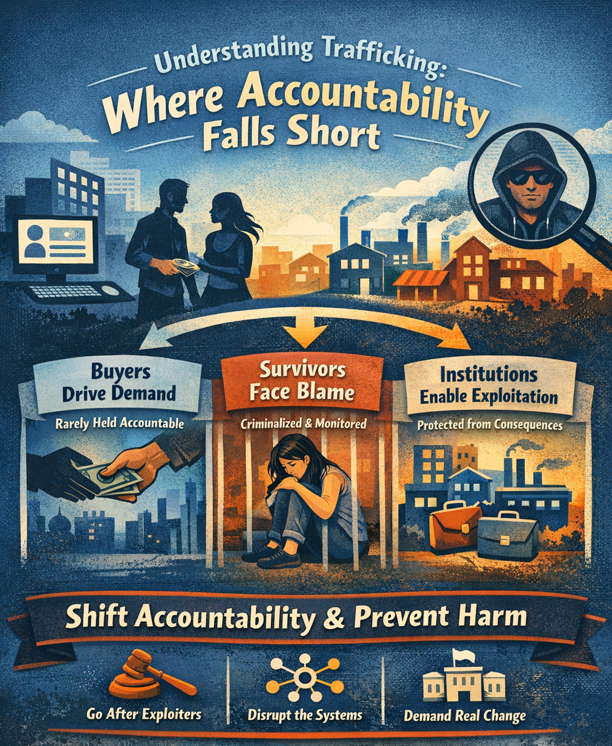
Buyers create the demand that sustains sexual exploitation, yet they remain largely absent from legislative and enforcement priorities. Across the United States, buyers are rarely the focus of trafficking-related laws. When accountability does exist, penalties are often minimal, inconsistently enforced, or framed as “deterrence” rather than acknowledgment of serious harm.
What is missing are strong federal statutes that clearly criminalize buying, public accountability measures that go beyond private diversion programs, and transparency around how often buyers are arrested or prosecuted compared to survivors. The continued silence around buyer behavior reinforces social norms that treat exploitation as inevitable or unchangeable, rather than preventable.
International guidance from the United Nations Office on Drugs and Crime has repeatedly identified demand reduction, including accountability for buyers, as a critical component of effective trafficking prevention, underscoring the gap between research and current policy approaches (UNODC, Toolkit to Combat Trafficking in Persons, 2008).
Possible paths forward include establishing clear legal consequences that reflect the seriousness of the harm caused by buying. Stronger state and federal statutes that explicitly criminalize buying, consistent enforcement across jurisdictions, and public transparency around buyer arrests and prosecutions would help shift accountability where it belongs. Accountability models that center harm, rather than private diversion programs that shield buyers from consequences, can disrupt demand and challenge social norms that excuse exploitation.
Traffickers: Narrow and Selective Accountability
Trafficking laws often focus on individual “bad actors” or highly visible, extreme cases. While these prosecutions matter, they fail to reflect how trafficking typically operates. Exploitation is frequently organized, facilitated, and normalized through networks that include financial, logistical, and social systems.
What is missing are broader definitions of trafficking facilitation, accountability for those who profit indirectly, and enforcement strategies that target financial and operational structures; not only street-level activity. When accountability stops at the most visible actors, the systems that allow exploitation to persist remain intact.
Synthesis reviews of human trafficking research consistently show that trafficking is a complex, multi-layered phenomenon, and that narrow enforcement strategies fail to address the underlying structures that sustain exploitation (Research and Training for Human Trafficking—RTA Project, Human Trafficking Evidence Synthesis, 2023).
Possible paths forward include expanding legal definitions of facilitation to encompass organizers, recruiters, financial beneficiaries, and others who sustain trafficking networks behind the scenes. Enforcement strategies that leverage financial investigations, asset forfeiture, and anti–money laundering tools can disrupt trafficking at a structural level, rather than relying solely on street-level arrests.
Institutions That Enable Exploitation
Perhaps the largest and least discussed gap in accountability is the role of institutions. Online platforms, hotels, property owners, employers, labor intermediaries, and even systems designed to provide care can enable trafficking; whether through neglect, profit, or policy design.
Despite this reality, legislation often avoids naming these entities directly. Institutions are frequently framed as partners rather than actors with power and responsibility. What is missing are mandatory reporting requirements, meaningful oversight mechanisms, and real civil or criminal consequences for knowing facilitation.
Legal and human rights scholarship has repeatedly noted that institutional accountability mechanisms exist but are underutilized, allowing enabling environments to persist without meaningful consequences (Office of the High Commissioner for Human Rights, 2023).
Possible paths forward include moving beyond voluntary compliance toward enforceable accountability. Mandatory reporting requirements, transparent oversight structures, and civil or criminal liability for knowing facilitation can shift incentives for institutions with the power to intervene. Accountability must be paired with enforcement, not just policy statements, to meaningfully reduce institutional complicity.
Survivors as the Point of Intervention
Even survivor-centered laws often continue to place the burden on those who have experienced exploitation. Survivors are frequently required to prove harm, disclose trauma, or navigate systems that monitor and scrutinize them; while exploiters remain largely invisible.
This dynamic reinforces a harmful imbalance: survivors are monitored, systems are trusted, and those causing harm evade accountability. What is missing is a fundamental shift in approach; one that treats trafficking as a structural failure rather than an individual crisis.
Human rights–based frameworks emphasize that meaningful prevention requires addressing the economic, legal, and social conditions that allow exploitation to thrive, while respecting survivor autonomy and dignity.
Why Awareness Matters
Awareness is powerful because it shapes public will. A knowledgeable and informed public is more likely to demand accountability from buyers, traffickers, and institutions; and to challenge policies that criminalize survivors instead of protecting them.
Human Trafficking Awareness Month offers an opportunity to move beyond recognition toward responsibility. When awareness leads to accountability, prevention becomes possible.