
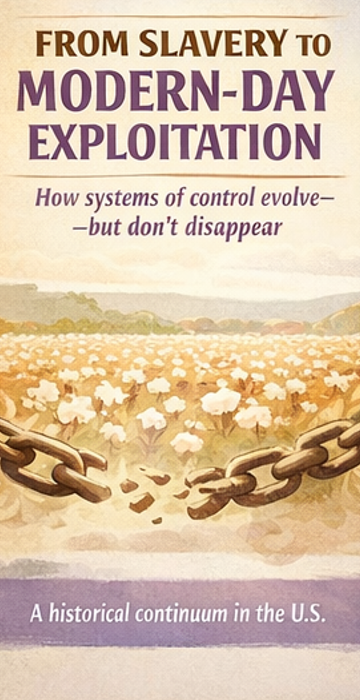
When people talk about the history of slavery in the United States, the focus is often placed on forced labor: fields, plantations, productivity, and profit. What is far less acknowledged is how sexual exploitation was not an unfortunate byproduct of slavery, but one of its core mechanisms. The sexual abuse of Black women and girls was deeply embedded in the system itself, sustained by law, economics, and social norms that erased consent and protected perpetrators. That this reality has so often been overlooked is not accidental; it reflects whose suffering was deemed visible, believable, or worthy of remembrance.
Under slavery, enslaved people were legally considered property, which meant they had no recognized right to bodily autonomy. In this context, the concept of consent did not exist for Black women and girls. Sexual violence could be carried out openly or covertly, framed as discipline, entitlement, or routine domination, with little fear of consequence. The law offered enslaved women no protection, and white enslavers were rarely held accountable. This legal erasure made sexual exploitation both widespread and difficult to name, creating a foundation of silence that continues to echo today.
Sexual exploitation was further obscured by the way slavery was publicly documented and remembered. Official records emphasized labor output, economic value, and land ownership, while sexual violence was treated as private or unspeakable. Acknowledging it would have exposed the abuse at the heart of white patriarchal power and disrupted the carefully maintained image of moral respectability among slaveholding families. As a result, historical narratives built primarily from these records often minimized or excluded the experiences of Black women altogether.
Profit motives also played a significant role in sustaining sexual exploitation. Enslaved women’s reproductive capacities were commodified, with forced or coerced pregnancy increasing an enslaver’s wealth through the birth of more enslaved children. This blurred the line between economic strategy and sexual violence, turning Black women’s bodies into sites of both labor production and biological extraction. Their ability to give birth became another asset to be controlled, monitored, and exploited.
Even in spaces that opposed slavery, sexual violence was frequently sidelined. Racist stereotypes portrayed Black women as hypersexual or undeserving of protection, while prevailing notions of respectability discouraged open discussion of sexual abuse. This combination of racism and misogyny created conditions where survivors were doubted, silenced, or pressured to endure in quiet resilience. Yet Black women did document their experiences. Harriet Jacobs’ Incidents in the Life of a Slave Girl offers a powerful firsthand account of the constant sexual harassment and coercion enslaved women faced, as well as the impossible choices they were forced to make to protect themselves and their children. For generations, narratives like hers were softened, questioned, or excluded from mainstream education because they were deemed too uncomfortable.
The formal abolition of slavery did not dismantle the systems that made exploitation profitable. Instead, forced labor and control of Black bodies evolved into new forms. Sharecropping, convict leasing, and indentured servitude emerged as mechanisms that maintained economic dependence and limited mobility for formerly enslaved people. These systems were reinforced by Jim Crow laws, racial terror, and disenfranchisement, ensuring that Black communities remained excluded from wealth, safety, and political power.
As the twentieth century progressed, discriminatory housing policies such as redlining, along with unequal access to education, employment, and healthcare, continued to concentrate poverty and instability in Black neighborhoods. These structural barriers did not disappear; they compounded over generations. Economic precarity, housing insecurity, and criminalization created conditions in which exploitation could persist, often taking new forms while maintaining familiar power dynamics.
Understanding this continuum is essential when examining modern sex trafficking and sexual exploitation. These harms do not exist in isolation; they are part of a historical throughline shaped by racism, gendered violence, and systemic neglect. Just as sexual exploitation during slavery was normalized and obscured, modern trafficking is often minimized, mischaracterized, or framed as individual failure rather than the outcome of structural harm. Black women and girls remain disproportionately impacted not by coincidence, but because the systems that once enabled their exploitation were never fully dismantled.
Recognizing sexual exploitation as a foundational element of slavery; and tracing its evolution through subsequent systems of coerced labor and social control; forces us to confront uncomfortable truths about both history and the present. Honoring Black history requires more than remembrance; it requires an honest reckoning with how past injustices continue to shape vulnerability today, and a commitment to disrupting the conditions that allow exploitation to endure.
References
Berry, D. R., & Harris, L. M. (2018). Sexual Violence and American Slavery. University of Georgia Press.
This work documents how sexual violence was a foundational mechanism of slavery and central to maintaining racial and gendered power.
Berlin, I. (2003). Generations of Captivity: A History of African-American Slaves. Harvard University Press.
Provides historical context for how slavery evolved over time and how systems of control adapted rather than disappeared.
Blackmon, D. A. (2008). Slavery by Another Name: The Re-Enslavement of Black Americans from the Civil War to World War II. Anchor Books.
Details the continuation of forced labor through convict leasing, peonage, and coercive labor systems after Emancipation.
Encyclopedia Virginia. (n.d.). Sexual Exploitation of the Enslaved.
https://encyclopediavirginia.org/entries/sexual-exploitation-of-the-enslaved/
Examines how enslavers used sexual violence and reproductive control as tools of economic and social dominance.
Jacobs, H. A. (1861). Incidents in the Life of a Slave Girl.
https://www.gutenberg.org/ebooks/11030
A primary source narrative detailing the lived experience of sexual coercion and resistance endured by enslaved Black women.
National Sexual Violence Resource Center. (n.d.). Sexual Violence Against African American Women and Girls.
https://www.nsvrc.org
Provides analysis of historical and contemporary patterns of sexual violence shaped by racism and gender inequality.
Library of Congress. (n.d.). Born in Slavery: Slave Narratives from the Federal Writers’ Project.
https://www.loc.gov/collections/slave-narratives-from-the-federal-writers-project-1936-to-1938/
Primary historical accounts that document violence, coercion, and survival strategies among formerly enslaved people.
National Fair Housing Alliance. (n.d.). Redlining and Housing Discrimination.
https://nationalfairhousing.org
Explains how discriminatory housing policies created long-term economic instability and vulnerability in Black communities.
U.S. Department of Justice. (n.d.). Human Trafficking and Vulnerable Populations.
https://www.justice.gov/humantrafficking
Connects modern trafficking vulnerabilities to systemic inequality and lack of access to resources.