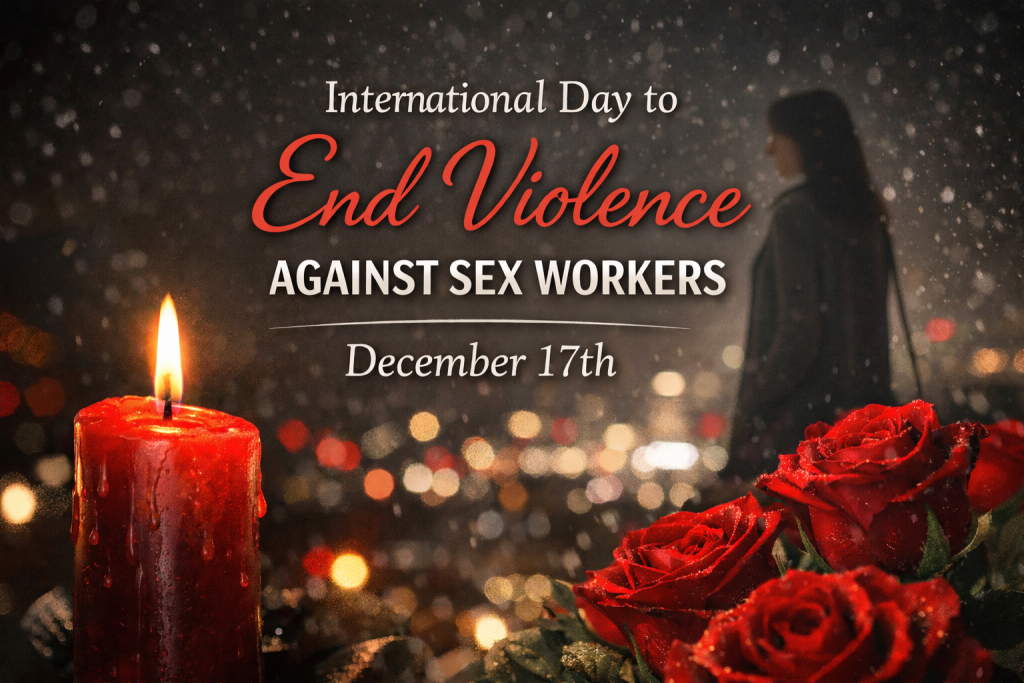
Each year on December 17, communities around the world observe the International Day to End Violence Against Sex Workers. The day was established in 2003 by sex worker–led organizations to honor the lives of people lost to violence and to draw attention to the systemic conditions that continue to put sex workers at risk.
What began as a memorial has grown into a global moment of reflection, advocacy, and responsibility. December 17 reminds us that violence against sex workers is not random or unavoidable; it is shaped by stigma, criminalization, and exclusion from safety and support.
Behind every statistic is a person. Remembering them is the first step toward changing how society responds.
Violence Against Sex Workers: A Well-Documented Crisis
Research consistently shows that sex workers experience disproportionately high rates of violence compared to the general population. Multiple studies across the U.S. and internationally have found that sex workers are far more likely to experience physical assault, sexual violence, robbery, and homicide than non–sex workers.
According to data published in the American Journal of Public Health, sex workers are estimated to be 10 to 18 times more likely to be murdered than the general population. Other studies indicate that between 45% and 75% of sex workers report experiencing physical or sexual violence at some point in their lives.
Importantly, this violence does not occur in a vacuum. Researchers consistently point to stigma, criminalization, and lack of access to legal protection and healthcare as major contributors. When people fear arrest or discrimination, they are less likely to report abuse, seek medical care, or access support services; conditions that perpetrators exploit.
Violence is not inherent to sex work itself. It is driven by environments where safety is denied and voices are silenced.
Stigma and Barriers to Safety
Stigma plays a significant role in increasing vulnerability to violence. When sex workers are portrayed as undeserving of protection or care, violence becomes normalized rather than challenged. Survivors may be dismissed, blamed, or disbelieved when they report abuse, reinforcing cycles of silence and isolation.
Research also shows that access to nonjudgmental healthcare and harm reduction services significantly reduces risk. When sex workers can access medical care, HIV and STI testing, overdose prevention tools, and trusted advocates, both violence and long-term health consequences decrease.
Change is possible when responses prioritize dignity, autonomy, and safety over punishment.
The Holidays and Heightened Vulnerability
December can be an especially difficult time for people experiencing exploitation. Cold weather, housing instability, and reduced access to services often increase physical risk. At the same time, the emotional weight of the holidays can intensify grief, trauma, and isolation.
Many outreach programs and support systems operate with limited capacity during this time, leaving fewer options for those who need help most. Research consistently shows that consistent, year-round access to services; especially during periods of increased stress; is critical to reducing harm and supporting long-term safety.
The need for care does not pause for the holidays, and neither does the opportunity to make a difference.
Moving Forward: What Reducing Violence Looks Like
The International Day to End Violence Against Sex Workers is not only about remembrance; it is also about responsibility. Across the country and around the world, organizations and advocates are working to reduce violence through survivor-led programs, harm reduction, healthcare access, education, and policy reform.
Evidence shows that when sex workers are trusted, supported, and included in the development of services, outcomes improve. Violence decreases. Health improves. Connection replaces isolation.
These approaches do not promise perfection or absolutes. They acknowledge complexity and focus on reducing harm, increasing safety, and affirming human dignity.
At Community Against Sexual Harm (CASH), we are proud to be part of this broader movement. As the need for survivor-led, harm reduction–based services continues to grow, we remain committed to expanding outreach, healthcare access, and peer support for women experiencing commercial sexual exploitation in our community.
If you are able, we invite you to support this work. Your contribution helps ensure that women have access to care, connection, and safety; not just on December 17, but every day of the year.
👉 Support CASH’s work: https://cashsacramento.org/give-a-gift/
Together, we can continue to challenge stigma, strengthen safety, and change the narrative.